

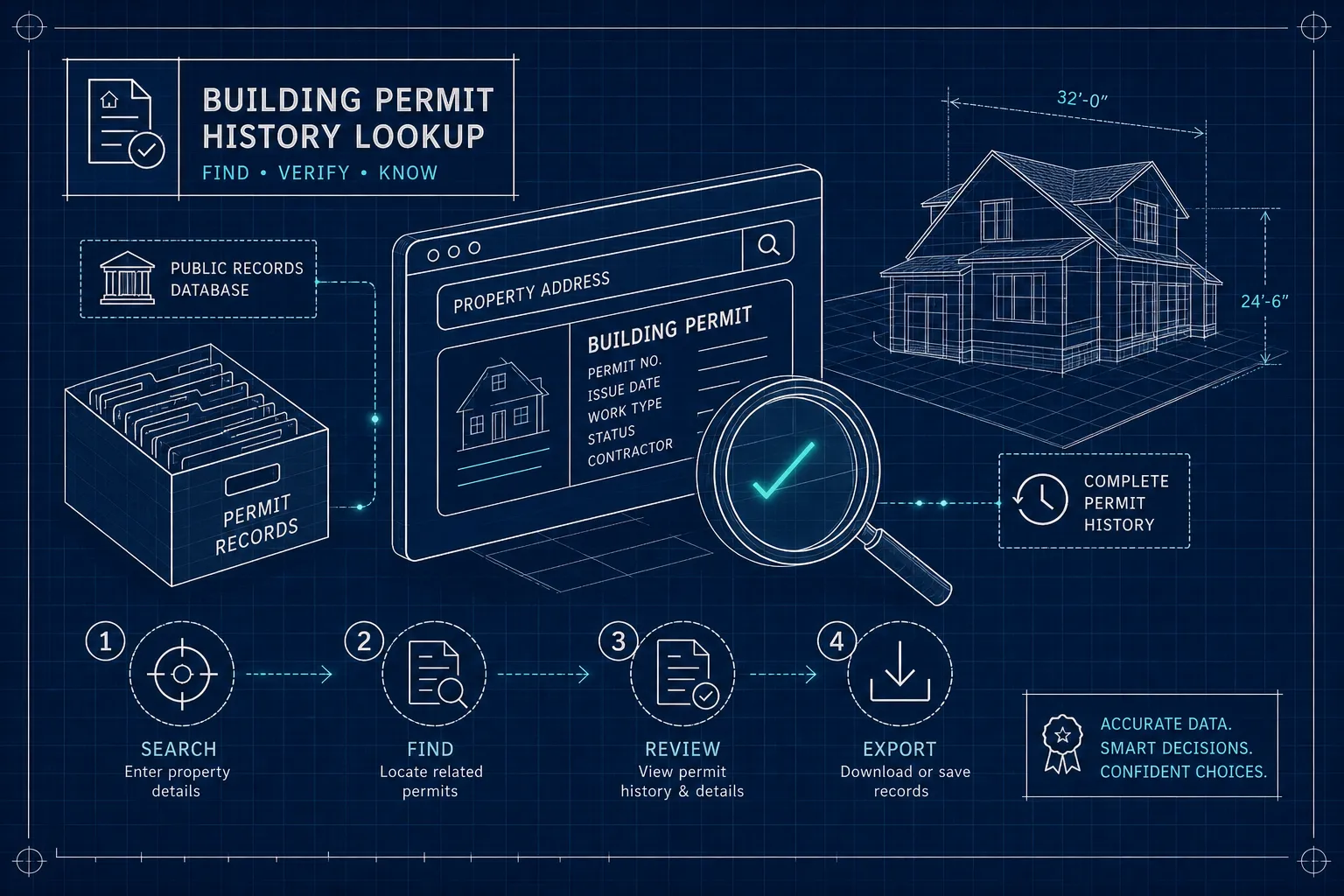
Before any remodel, purchase, or permit application, you need to know how to find building permit history for an address so you can confirm what work has already been done on a property and whether it was ever officially approved. Gaps in that record can cost you tens of thousands of dollars: unpermitted additions, open code violations, and structures that never passed inspection become your problem the moment you sign the deed or pull a new permit. Firms that specialize in as-built documentation encounter undocumented properties regularly, and the process for resolving them always starts in exactly the same place: the permit record.
This is a practical, step-by-step breakdown. The sections below walk you through identifying the right portal for your address and running searches using multiple keys. You’ll also learn how to read what the records actually tell you and how to request archived files when the database comes up empty, including what comes next when the permit trail disappears entirely.
How to Find Building Permit History for an Address: Choosing the Right Portal
The biggest mistake people make when looking up property permit records is assuming there’s one universal system. There isn’t. Los Angeles County has 88 incorporated cities, many of which run their own building permit departments and, in many cases, their own permit portals.
If your property is within the City of Los Angeles, start with LADBS (Los Angeles Department of Building permit and Safety) and its PermitLA permit and inspection report tool. Navigate to the portal, enter the street number and street name in the address search field, press Enter, and select the matching address from the results list. From there, you’ll see permit applications and issued permits indexed to that property, covering building, electrical, mechanical, and plumbing work, as well as plan-check applications. The LADBS PermitLA lookup is the primary building records lookup tool for any address within city limits.
Cities within LA County that operate completely outside LADBS include Pasadena (which uses EnerGov), South Pasadena (which uses Accela), Long Beach, Torrance, Carson, and Whittier, among others, each with its own building permit department portal. Unincorporated areas of the county, meaning areas not within any incorporated city, fall under LA County’s Department of Regional Planning and use the county’s EPIC-LA system. The fastest way to determine which department has jurisdiction is to confirm whether the address is inside an incorporated city or an unincorporated county area.
Many of these city portals run on Accela Citizen Access, a common permitting platform used by municipalities across California and the country. The general workflow is consistent across Accela-based portals: choose a search type, enter your key, and review the matching records. Many Accela portals allow anonymous searching for basic permit information without requiring you to create an account.
LADBS Records Search: Running Searches by Address, Parcel Number, and Permit Number
Start every LADBS records search with the street address. Enter the house number and street name, and pay attention to how the portal expects the address formatted. Some systems abbreviate street suffixes (St., Ave., Blvd.) while others expect the full spelling. If your first attempt returns no results, try stripping the suffix entirely or using a partial address, older properties sometimes have legacy address formats that don’t match a full, current address entry.
When the address search returns incomplete results or nothing at all, switch to a permit number search if you already have a permit number from a title report, disclosure document, or previous search. This pulls the exact record without relying on address indexing. A parcel number search is the most powerful fallback, particularly for corner lots, subdivided parcels, and properties that have been re-addressed over the years. The Assessor’s Parcel Number (APN) is the bridge between the permit system and county property records, and using it often surfaces permits that a street address search misses entirely.
Using LA County Assessor Records When Your Address Search Comes Up Empty
The LA County Assessor’s portal at assessor.lacounty.gov lets you search by address, owner name, or map location to retrieve the official parcel record. From that result, you can pull the APN, legal description, lot dimensions, and ownership history, all of which help you confirm you have the right property before running a permit search. For properties inside the City of Los Angeles, the ZIMAS parcel viewer also lets you visually confirm parcel boundaries on a map, which is useful when an address is ambiguous or a lot has been subdivided.
Once you have the APN, return to PermitLA or the relevant municipal permit portal and run a new search using the parcel number field instead of the address field. This method consistently surfaces permits that were indexed to the parcel rather than the street address, a pattern common with older records and properties that have been re-addressed over time. APN-based permit searches are the most reliable fallback when an address search produces incomplete results, and they should be your standard second step rather than an afterthought.
What to Look for in Your LADBS Permit Records
The most important field to check first is permit status. A status of “Finaled” means the work passed final inspection and was legally closed out by the city. “Open” means the permit is still active but hasn’t been finaled, which often signals unfinished or abandoned work. “Expired” is a problem status: the permit lapsed before final approval, so the city never confirmed the work was completed to code. “Inactive” is a warning sign that the permit has stalled and follow-up is likely needed.
Next, read the scope of work carefully. This field describes what was specifically approved, and comparing it to the actual condition of the property tells you whether additional work was done beyond the approved scope. A permit for “kitchen remodel” doesn’t cover a new bedroom addition visible on the same side of the house. Also check the issue date against visible construction: work that predates the permit issuance may indicate the project started before approval was granted.
The inspection history section shows each required inspection, its date, and whether it passed or failed. Multiple failed inspections before a final pass are common and not necessarily alarming. What matters is whether the permit ultimately reached a final approved status. The most significant red flag in any permit record search is no permits at all for a structure or addition that clearly exists on the property. That finding points directly to an undocumented condition, which requires a different approach than a standard permit review.
How to Request Historic or Non-Digitized Permit Files
Buildings constructed before the 1990s or early 2000s often have permit records stored as paper files or microfilm that haven’t been digitized. For LADBS properties, the process involves completing a Records Research Request Form and submitting it by email to Records.LADBS@lacity.org or by appointment at an LADBS office. Your request should include the exact street address, the APN, the approximate year of construction or work, the specific document types you need (permits, plans, certificates of occupancy), and whether you prefer digital copies or an in-person review.
For other LA County cities, check the building department’s website for a public records request form or contact the department directly to ask about their records retrieval process. Response times for digitized records are typically fast. For archived or physical files, plan on 7 to 10 business days as a baseline, and expect longer turnaround for complex or high-volume requests. Fees vary by jurisdiction: some cities charge a flat research fee, others charge per-page copying fees, and LADBS typically quotes the applicable cost after locating the records.
When Permit Records Are Missing or the Structure Was Never Documented
A property with no permit records for additions, conversions, or structural work doesn’t automatically mean those improvements were built incorrectly. It does mean there is no official record that they were built to code, and that distinction matters enormously when you try to sell, refinance, or pull permits for new work. In Los Angeles, this situation is common with older homes that have informal room additions, converted garages, or unpermitted ADUs. The city cannot approve new work on a structure with undocumented existing conditions without first resolving what’s already there.
When permit records are missing and no approved drawings exist, the path forward is to create accurate as-built drawings that document the existing conditions: measured in the field, drawn to current LADBS standards, and submitted as part of a legalization or new permit application. This is one of the most common scenarios documentation specialists work through with property owners. Consider a situation where a homeowner needs to pull a permit for a bathroom remodel and discovers that a back addition from the 1980s was never permitted. Before the city will approve anything new, that condition has to be documented and often brought into compliance.
Field-measured, LADBS-compliant as-built drawings give the contractor, architect, and building department a clear and accurate baseline for what the structure looks like today.
Getting from the Permit Record to a Clear Path Forward
Knowing how to search LADBS permit records is only the first step. Start with PermitLA or the relevant city portal, use the APN as your fallback when an address search produces incomplete results, read the records carefully with attention to permit status and scope of work, and submit a formal records research request when you need older or archived files. When the trail goes cold entirely, that’s not the end of the road, it’s the starting point for getting the building properly documented.
A missing permit record means the work was never officially closed out, not necessarily that it can’t be legalized. The real question is what the building actually looks like today and how to document that accurately enough for LADBS to act on it.
If you’re working with a property in Los Angeles County that has gaps in its permit history, open or expired permits, or structures with no approved drawings on file, As-Built Drawings Los Angeles can measure and document the existing conditions in a format LADBS will accept. Get in touch with our team to discuss what the property needs and how we can get the documentation in order.


